
There are many famous prefaces and introductions to the great and the good books of human tradition. Some are masterpieces in their own right, able to be studied with profit apart from the main work. One thinks of the prefatory materials to Kant’s Critique of Pure Reason; of Hegel’s introduction in The Phenomenology of Spirit; of Newton’s “Letter to the Reader” in his Principia; of Ptolemy’s preface in The Almagest; of the various programmatic prefaces of Aristotle (Physics, I.1, Metaphysics, I.1–2, or Nicomachean Ethics, I.1–3); of De Tocqueville’s preface to Democracy in America; of the masterful prooemia of St. Thomas in his Aristotelian commentaries—not to mention those of his own theological works (such as Summa Theologiae, Ia, q. 1, or Summa contra Gentiles, I.1–9, II.1–5, III.1, and IV.1). Even novels such as Don Quixote or The Scarlet Letter feature well-known introductions. The great operas have their overtures which preview and anticipate the musical arcs and themes of the whole; so too do literary prefaces and introductions sketch the architectonic lines of and set the stage for works of fiction, history, philosophy, and theology.
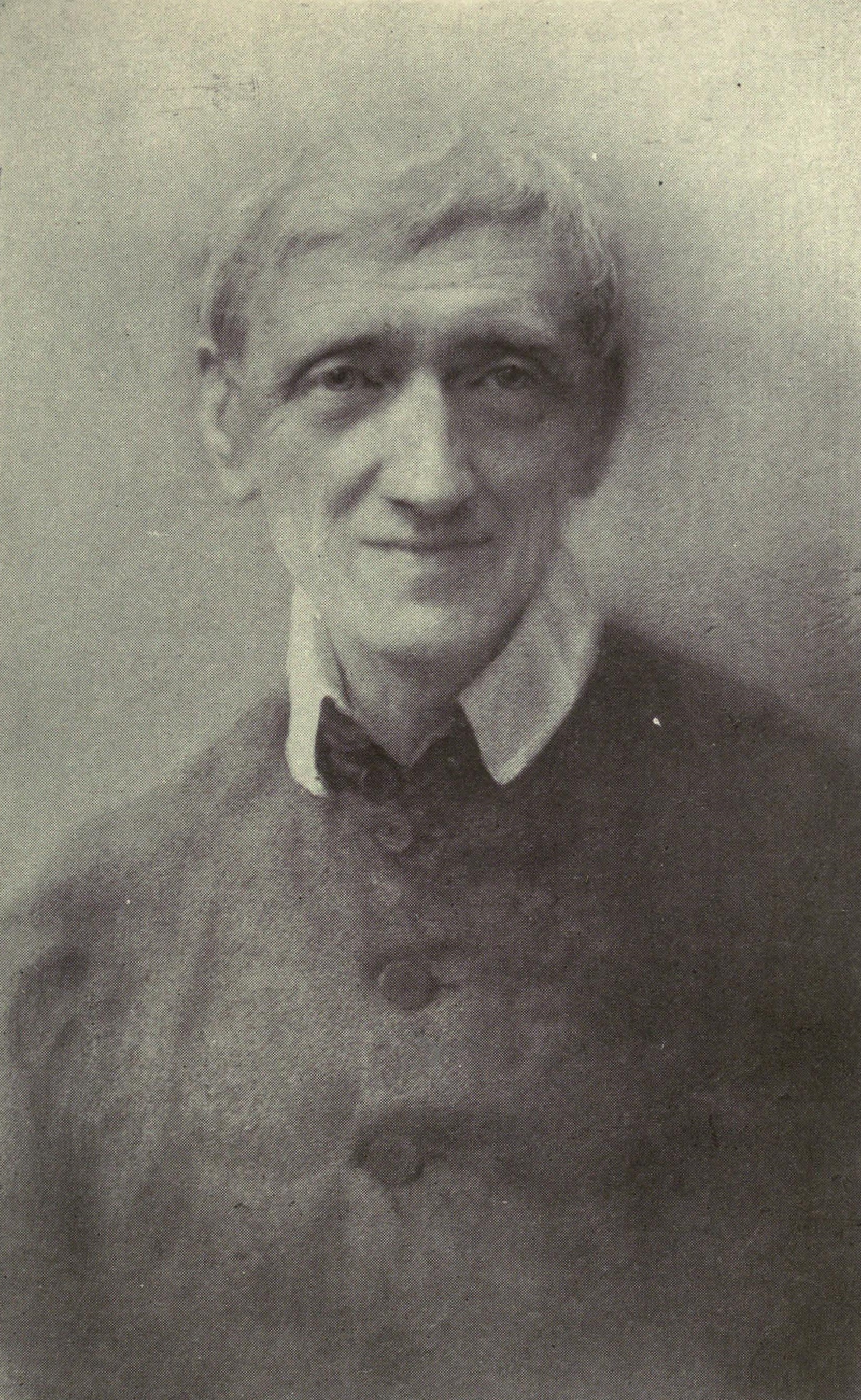
St. John Henry Cardinal Newman’s An Essay in Aid of a Grammar of Assent, however, has neither a preface that explains its aim and context nor a dedicated introduction that outlines its principal claims and arguments. Although its first chapters are described as “introductory” by Newman, the scope of the Grammar’s project is allowed to unfold slowly. Apart from its title, epigraph, table of contents, and what rumor or report its audience receives, the book would seem to begin in media res.
In honor of St. John Henry Newman’s feast day, I present my transcription of a draft of his preface to the Grammar of Assent.
Preface: On the nature, mode, and grounds of religious assent[1]
St. John Henry Cardinal Newman
|1|
Quoniam {igitur} expectavi, et non sunt locuti; steterunt nec ultra responderunt; respondebo et ego partem meam, et ostendam scientiam meam.[2]
I have long wished to put on paper the thoughts which are the subject of the following pages. Many Catholics indeed there are far better versed than I can be in the old and true philosophy, and capable of expounding and defending with far more authority and exactness this matter which I have attempted to defend in my own way. This is the plain fact; but, when those who can speak with effect are silent, they must not be surprised, if, in the time of an intellectual earthquake, when the opinions of men are stirred from their very foundations, and a revolution is passing over the ideas of the civilized world more appalling than any uprooting of thrones however venerable, or upheaving of civil institutions, however ancient, those who are but journeymen in metaphysical science speak instead of them. And for myself this can I say for my own approach, that, deeply conscious as I am of the many mistakes which I must have made in a subject at once so delicate and |2| so abstruse, yet the experience of my past life teaches me for my encouragement that views are not therefore despicable, or without promise of ultimate influence and success, because, when first presented to the notice of some particular generation or country, they are popularly pronounced to be out of date, extravagant, and untenable. Nay, if I fail in my attempt, I still may solace myself with the belief that my failure is a preliminary condition to the success of others who come after me, and may even contribute to it. Anyhow, I feel it more honorable, in such a crisis as this, to venture on what to my strength is a forlorn hope, than to do nothing.[3]
| |3| (A) | |6| (B) |
| (A1) This {work is} mainly for the sake of Catholics; when I turn to those who are not so, I have this additional excuse for my present attempt, that if I fail, I have no proof that any of them have succeeded better in the few promises of metaphysics. They have devised system after system, which have been strong indeed severally to destroy all which arose before them, but impotent to keep the ground which they have conquered. General and fecund reception used to be accounted a necessary attribute of truth; but, says a recent German writer, “the latest school has expressly characterized its philosophy as an esoteric science, which would at all times remain confined to the narrow circle of the initiated; yea more, which is also intended to be solely confined to them, inasmuch as what constitutes it Philosophy is, that it does not lay aside its veil—which is impervious to the eyes of the uninitiated—its scientific garb.”[4] That is, it is the attribute of metaphysical truth that its causes be proved: magna est veritas et non praevalebit.[5] | (B1) This {work is} mainly for the consideration of Catholics; but when I turn to those who are not so, I do not speak so diffidently, and for this simple reason, because, if I have failed in what I have attempted in the province of mental philosophy, there is not proof that they have succeeded better. “The latest school,” says a German writer, “has expressly characterized its philosophy as an esoteric science, which would at all times remain confined to the narrow circle of the initiated; yea more, which is also intended to be solely confined to them, inasmuch as what constitutes it Philosophy is, that it does not lay aside its veil, which is impervious to the eyes of the uninitiated, its scientific garb.”[6] That is, it is the attribute of truth in metaphysical speculations that it cannot be proved. |
| (A2) If this view of the matter be correct, such philosophers |4| cannot be surprised if Catholics claimed to have their own esoteric incommunicable system, which they indeed themselves on their own principles felt to be demonstrative, though it was not so on the principles of others, and if it be not correct, then again it need not excite surprise, if, in the existing anarchy, and in the interests of a prospective science which as yet is not formed, even an individual Catholic, like myself, ventures to hope that, though his argument be only probable, still it has a claim on the attention of others, and has a chance of at least pointing towards truths which it may not reach. | (B2) Whether this be a sound argument or not, I will not decide; but at least it is a confession of the fact that no system of philosophy has as yet approved itself to the intellectual world. As to the argument built upon it, if it be tenable, then there is no reason why Catholicism may not assert its own esoteric, incommunicable metaphysics, as well as Hegelianism and its offshoots. |7| If it is not tenable, then, in the existing anarchy, and in the interests of a large science hereafter to be discovered, I have as good a title to speak as another. |
| (A3) It is with these sentiments that I have ventured on the investigation which follows. If I have not recognized the tenets nor used the language of existing schools of thought, this has been no want of respect for them, but because, at a time when neither doctrine nor terminology is soundly settled, to adopt their standpoints or their broad generalizations would but involve me in their engagements and subject my meaning to misconception. My path is different from theirs; and as one crossing the Alps into Italy by the pass of St. Gotthard should find it superfluous to be well up with the Brenner or Mont Cenis, |5| <so I consider my way to their way. I wish {to} affirm {that having} shown such conduct is no reason of disrespect; it is to grant that I must find my own views to be worth something in themselves, before I proceed to pit them against theirs.>[7] | (B3) And in saying this I have described the exact position which I wish to take up: I am not proposing directly to assail the current opinions of the day, but to state my own, which I think no less probable, but, on the contrary, more probable than any other. It is sufficient for my purpose if they are at least probable and worthy of consideration; for if they are as much as this they will serve to relieve those who are at once revolted and perplexed by the opinions at present in vogue by showing them that they are not yet under the necessity of surrendering their most intimate, sacred, and vital sentiments and instinctive judgments, under pain of being relegated by the voice of a unanimous world to some limbo of |8| antiquated error. |
| (A4) For the same reason, if I have made frequent use of the first person in the course of my inquiry, it is my conviction that at this moment an individual writer can only speak for himself, and deliver his personal testimony on subjects completely obscure. In a metaphysical work egotism is the truest modesty. | (B4) For the same reason, I am not bound even to notice or criticize or adjust myself with the schools of the day. If indeed metaphysics were a science such as physics or astronomy, or even geology, having its undisputed first principles and generalizations, its received method and order of thought, its recognized terminology, it would seem to be folly to ignore its masters and their writings. But in the existing discordance of opinion, and variations in nomenclature, I shall not only be burdening myself with a needless labour, did I attempt to perfect myself in the teachings of any particular school, however considerable, and should, by using its language, involve myself in unknown ways in its philosophical arguments, and be not unnaturally interpreted in whatever I advanced by their peculiar tenets. |
| (B5) Expedience then, not less than my right, leads me to use words in my own technical sense, provided that I state what that sense is: and |9| to lay down my own theses in my own way, so that I give my reasons for holding them. If indeed the line of theory {that} be reasoned out by others so crosses mine as to destroy my throughway, then I should be bound of course to make a passage in spite of it as best I could; but if, to take an illustration, in crossing the Alps into Italy, I prefer to go by the St. Gotthard pass, I may without blame leave the railroad of Mont Cenis or Brenner to cross them alone. |
TRANSCRIPTION
Newman, John Henry, Cardinal, 1801-1890
Draft of a preface – On the nature, modes and grounds of religious assent
Identifier: B139-F003-D002
Call Number: B139-F003-D002
Collection: Birmingham Oratory
Creator: Newman, John Henry, Cardinal, 1801-1890
Date: 1868-12-30
Page Count: 7 scanned pages; 9 physical pages
Location: e-resource|Birmingham Oratory
Type: Text
Content Type: Manuscript
Language: English, with some Latin
* * *
Key for the Transcription
[text struck through] by JHN, replaced by text written on the line above
[main line word/phrase not struck through] with alternate word/phrase on the line above
{{JHN editorial comment}}
{Transcriber-interpolated word}
* * *
|1|
Dec 30 / 68 Preface On the nature, mode, and grounds
of religious assent
Quoniam {igitur} expectavi, et non sunt locuti; steterunt
nec ultra responderunt; respondebo et ego partem meam, et ostendam
scientiam meam.
I have long wished to put on paper the thoughts which are
the subject of the following pages. Many Catholics indeed there are far better
capable of expounding
versed than I can be in the old and true philosophy, and [far better gifted to]
with far more authority and exactness
and defending ^ this matter which I have attempted to defend in my own way.
This is the plain fact; but, when those who can speak with effect are silent,
they must not be surprised, if, in the time of an intellectual earthquake, when
the
^ opinions of men are stirred from their very foundations, and a revolution is passing
over the ideas of the civilized world more appalling than any uprooting of thrones
venerable upheaving
however [august], [and the] or [overthrow] of civil institutions, however ancient, those
who are but journeymen in metaphysical science speak instead of them.
can I say for my own approach
And for myself this [alone will I say], that, deeply conscious as I am of the
many mistakes which I must have made in a subject at once so delicate and
|2|
so abstruse, yet the experience of my past life teaches me for my encou-
or without
ragement that views are not therefore despicable, [because] promise of
presented to
ultimate influence and success, because, when first [afforded] the notice
of some particular generation or country, they are popularly pronounced
to be out of date, extravagant, and untenable. Nay, if I fail in my
attempt, I still may solace myself with the belief that my failure is
preliminary condition to
a [necessary first step in] the success of others who come after me, and may
to
even contribute [towards] it. Any how I feel it more honorable, in such
crisis venture on what
a [day] as this, to [take my place in] to my strength is a forlorn hope,
than
[and to] to do nothing. {{Go on A or B.}}
benefit
[{A} This mainly for the [sake] of Catholics; but, I turn
plain
to those who are not so, I do not speak so diffidently, and for this ^ reason,
attempts at mental analysis I am for
because, if I am wrong on my [illeg.], this is no more than what they are
are
in theirs. Even if my own theories and arguments [be] not proof against ad-
verse criticism, I am sure theirs are not, and I can afford to be rash,
or hazy, or shallow in their estimation, when, (if I may say so without]
|3|
A.
This {work is} mainly for the sake of Catholics; when I turn to those
who are not so, I have this additional excuse for my present attempt,
better
that if I fail, I have no proof that any of them have succeeded ^ in the
few promises
[promise] of metaphysics. They have devised system after system, which have
{3} {1} {2}indeed all
been severally strong to destroy [those] which arose before them, but impotent
the ground which
to keep [what] they have conquered. General and fecund reception used to be
accounted a necessary attribute of truth; but, says a recent German writer, «the
latest school has expressly characterized its philosophy as an esoteric
science, which would at all times remain confined to the narrow circle of
the initiated; yea more, which is also intended to be solely confined
to them, inasmuch as what constitutes it Philosophy is, that it does not
lay aside its veil—which is impervious to the eyes of the uninitiated—
{{Chalibaus, p. 17}} That is
its scientific garb.» [Illeg.], it is the attribute of metaphysical truth
that its causes be proved: magna est veritas et non praevalebit.
If this view of the matter be correct, such philosophers
|4|
cannot be surprised if Catholics claimed to have their own esoteric
incommunicable system, which they indeed themselves on their own prin-
ciples felt to be demonstrative, though it was not so on the principles of others,
and if it be not correct, then again it need not excite surprise, if,
in the existing anarchy, and in the interests of a prospective science which
formed, even ventures to hope
as yet is not ^ an individual Catholic, like myself, [thinks] that [what is only
only probable
probable though his argument be [nothing more], still it
[probably true], ^ has a claim on the attention of others, and has a chance of
may
at least pointing towards truths which it [does] not reach.
It is with these sentiments that I have ventured on the
investigation which follows. If I have not recognized the tenets nor
used the language of existing schools of thought, this has been no want of re-
spect for them, but because, at a time when neither doctrine nor terminolo-
adopt their their broad generalizations [definitions]
gy is soundly settled, to [start from their] standpoints or [to use]
but meaning [of my own meanings]
would ^ involve me in their engagements and subject my ^ to [endless] misconception.
by the pass of St. Gotthard
My path is different from theirs; and as one crossing the Alps into Italy ^
should find it superfluous to be well up with the Brenner or Mont Cenis.
|5|
I have shown
So I consider my way to their way, if I [illeg.] I wish affirm my having to
I [find I ought to be]
And in like manner such conduct is no reason of disrespect; it is
For the same reason to grant that I must find my own views to be worth something in themselves, before
[On the other hand], if I have made frequent use of the first person in the
pit them in [illeg.]
it is my I proceed to pit them against theirs
course of my inquiry, [this has been the] conviction that at this
moment an individual writer can only speak for himself, and deliver
his personal testimony on subjects completely obscure. [and that] In a
metaphysical work egotism is the truest modesty.
{{The End}}
|6|
B.
This {work is} mainly for the consideration of Catholics; but
when I turn to those who are not so, I do not speak so diffidently,
simple
and for this [plain] reason, because, if I have failed in what I have
attempted in the province of mental philosophy, there is not proof that
they have succeeded better. «The latest school» says a German writer,
{{Chalibaus, p. 17}}
«has expressly characterized its philosophy as an esoteric science,
which would at all times remain confined to the narrow circle of the
initiated; yea more, which is also intended to be solely confined to
them, inasmuch as what constitutes it Philosophy is, that it does not
lay aside its veil, which is impervious to the eyes of the uninitiated,
it is the attribute metaphysical
its scientific garb.» That is, [the criterion] of truth in [philoso-
not
phical] speculations is that it can^ be proved.
[I am not deciding] Whether this be a sound argu-
I will not decide; but at least it is a confession of the fact {*}
ment or not, [but so far is plain] : {.} {**} if it be tenable [sound], then there
{*}that no system of philosophy has as yet approved itself to the intellectual world.
{**} As to the argument built upon it
is no reason why Catholicism may not assert its own esoteric, in-
communicable metaphysics, as well as Hegelianism and its off-
|7|
but
shoots. If it is not tenable, [and the present discordance of philosoph
ers which is as interminable as it assumed it to be], then, in the exist-
ing anarchy, and in the interests of a large science hereafter to be dis-
have as good a title
covered, I [may assurably speak as] to speak as another.
And in saying this I have described the exact po-
am not proposing
sition which I wish to take up: I [have not wish] directly to assail
[the] current opinions [of the day], but to state my own, which I
think no less probable, but, on the contrary, more probable than any
at least
other. It is sufficient for my purpose if they are [undeniably] probable
and worthy of consideration; for if they are as much as this they
serve to relieve at once
will [relieve those] those who are ^ revolted and perplexed by the
opinions at present in vogue by showing them that they are
under the necessity
not yet [in the dilemma] of surrendering their most intimate and
and vital
sacred ^ sentiments and instinctive judgments, under pain of being
relegated by the voice of a unanimous world to some limbo of
|8|
antiquated error.
For the
[This being] same reason I am not bound even to notice
criticize or adjust myself with
or [recognize] the schools of the day. If indeed metaphysics were a
such as
science [like] physics or astronomy, or even geology, having
undisputed first principles and generalizations
its [received formulas], [its undis] its received [undisputed] method
its recognized terminology it would seem to be folly
and order of thought, ^ [I should have not right] to ignore its masters
[why as it is, I shall not only]
and their writings. [As if [illeg.] should I encumber myself with Saul’s
But in the existing discordance of opinion, and
armour, when it is not only]
variations in
[multiplicity of] nomenclature, I shall not only be burdening myself
a perfect tenets
with [the] needless labour, did I attempt to [make] myself in the [teachings]
particular its
of any ^ school, however considerable, and should, by using [their] language,
involve
[commit] myself in unknown ways in its philosophical arguments, and
be not unnaturally interpreted in whatever I advanced by their peculiar
tenets.
not right [my][words]
Expedience then, [and] less than my [liberty], leads me to use words
[own technical words]
[as it is naturally to] provided that I state what that sense is: and
in my own technical sense
|9|
to lay down my own theses in my own way, so that I give my reasons for
holding them. If indeed the line of theory {that} be reasoned out by others so crosses
should be
[my] mine as to destroy my throughway, then I [am] bound of course to make
in spite of
a passage though it as best I could; but if, to take an illustration, in
crossing the Alps into Italy, I prefer to go by the St. Gotthard pass, I
may without blame leave the railroad of Mont Cenis or Brenner
to cross them
alone.
[1] Transcribed 3 Oct 2022 by John G. Brungardt. The rectified text presented above is based upon my transcription of Newman’s manuscript. That transcription begins on p. 4, and its pagination is placed in bars, like so: |1|, both in the transcription below and the rectified text above.
[2] Job 32:16–17: “Therefore because I have waited, and they have not spoken: they stood, and answered no more: I also will answer my part, and will shew my knowledge.”
[3] Newman indicates that either (A) or (B) is to be used in the remainder. An initial continuation—labelled “A” even though its few lines resemble “B” more closely—was crossed out. See the transcription below, p. |2|.
[4] H. M. Chalybäus, Historical Development of Speculative Philosophy, from Kant to Hegel, trans. by A. Edersheim (Edinburgh: T. & T. Clark, 1854), 17. URL: <https://archive.org/details/historicalphilo00chaluoft/page/n19/mode/2up>.
[5] Newman recasts the apocrypha in 3 Esdras 4:41: “Magna est veritas et praevalet.” Great is the truth and it prevails. His line reads “Great is the truth and it will not prevail.”
[6] This is the same citation from Chalybäus, see above, fn. 4.
[7] The sentence in angle brackets, < … >, is my reconstruction of the various edits on the top of p. |5| of the manuscript.
 John G. Brungardt
The Newman intro is fascinating!
Thanks!
John,
Have you written anything else on the Grammar of Assent? Do you think you have a decent grasp of it?
In Christ,
Andrew
Andrew T. Seeley, PhD
When I discovered your teaching, I devoured it.
Hi, Andrew,
I don’t have anything else written, no. While I’m not an expert, I have been developing a decent grasp of the Grammar—it’s a text I use in a course every fall.
pax,
JGB