
Updated: The following is based upon my remarks at the inaugural meeting of the Institute on the Catechism.
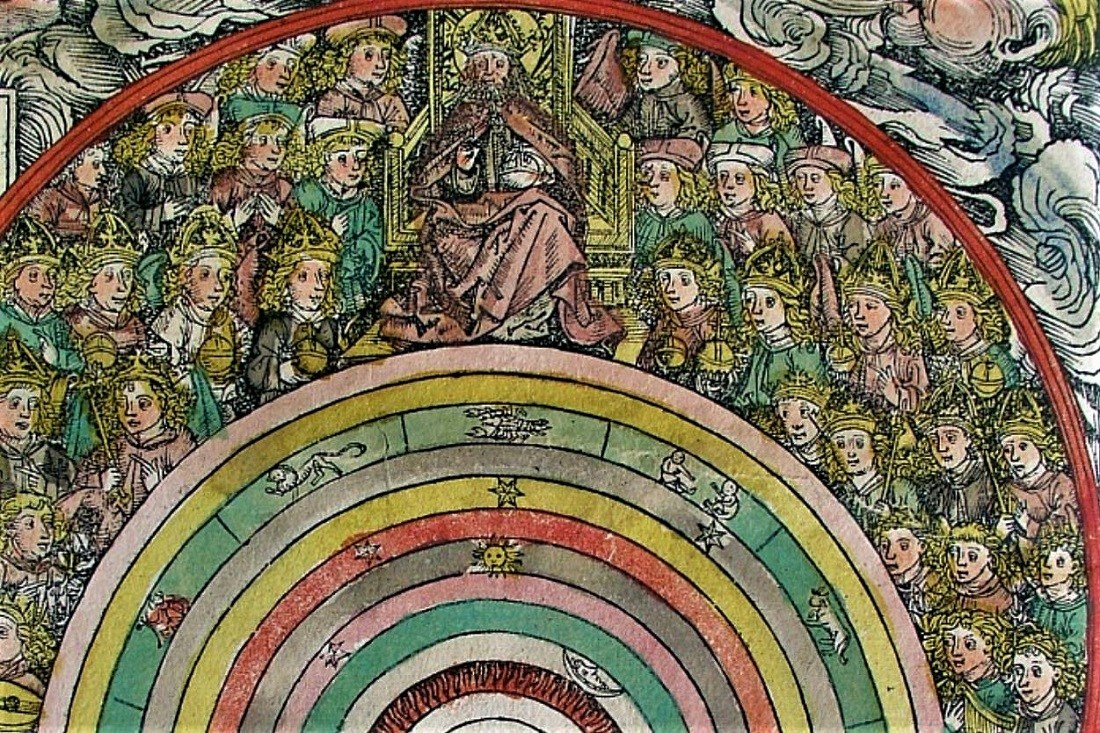
I have been tasked with talking about the place of human nature and sexuality in the cosmos. To fulfill this task, I would like to sketch two competing paradigms for understanding that place. The first is older, and more difficult for us to remember. It is the harmony and order of creation.
The harmony of creation is a luminous truth; as Pope Francis says: “Everything in the world is connected.”[1] St. Thomas argues that the very essence or “form of the universe consists in the distinction and order of its parts,”[2] because “out of all creatures the whole universe is established, just as a whole is from parts.”[3] The poet Dante writes: “All things possess / order amongst themselves: this order is / the form that makes the world resemble God.”[4] Again, “‘the book of nature is one and indivisible,’ and includes the environment, life, sexuality, the family, social relations,”[5] and more.
Within the harmony of creation, the human person is a metaxy, a creaturely bridge in the midst of it all. We are somewhere between apes and angels. St. Thomas writes: “The human soul exists on the border of corporeal and incorporeal substances, on the horizon, as it were, of eternity and time. Receding from the depths, it draws near to the heights.”[6] That receding from the depths of matter is almost a description of evolution. Biologically, evolution seeks the survival of species, in which perpetuation of species is a distant likeness of God’s eternity. Within the history of the world, the stochastic agency of material processes is shot through with a purposeful design, the rotating gallery of God’s wisdom and artistry at work in the natural order,[7] and in this gallery God’s own image has a chosen place and time.
Consider that image, the human person: We find joined within ourselves and our actions nature and grace, faith and reason, matter and spirit, good and evil. Within the human species are diversities of diversity: peoples, races, nations, languages, and cultures. In particular, the human sexual dimorphism is a principle of profound connection and unity. Our sexual distinction into male and female is incorporated in human nature in a way distinct from other animals: we are sexual, marital, and familial animals in a way that is not found elsewhere in creation.
A woman is a human female, naturally apt to “produce offspring from within herself through receiving from a male in sexual intercourse,” and a man is a human male, naturally apt “to produce offspring outside of himself through giving to a female in that same activity.”[8] This human sexual dimorphism is a principle, a beginning, of a range of diverse forms of unity: the sexual difference is a principle of marital union. Marriage is, in turn, the principle of familial union, which in turn is a principle of generational union within family. We rightly consider “a whole human life to include woman or man being able to see their children and their children’s children.”[9] In turn, intergenerational relationships are the beginnings of small communities and, in time, the social orders, all of which are the natural substrates for the grace of the family of families, the Church. Indeed, “The merging of nature and civilization is nowhere more vividly on display than in the love between man and woman.”[10]
Such connectivity within the diversity of God’s creation and human civilization can only be parodied within “the dominant technocratic paradigm”[11] of our age. Pope Francis recognizes this paradigm only to forcefully reject it. The technocratic paradigm is the desire and subsequent attempt “to turn reality into an object simply to be used and controlled.”[12] This paradigm attempts to divide and conquer, to master and possess for the sake of the desires of the world, in that sense of “world” opposed to the divine intentionality instilled within creation. It looks upon the first paradigm as the raw material for the fulfillment of its desires.
The technocratic paradigm strives to turn human sexuality, marriage, family, economy, and society into so many moving parts in a machine-civilization. It looks upon man and woman as a principle as mere objects: manipulable, alterable, taxable, retrainable, consumable, disposable, computerizable, contraceptible, abortable, surgically alterable, etc. T. S. Eliot expresses this well when he writes: “They constantly try to escape / From the darkness outside and within / By dreaming of systems so perfect that no one will need to be good.”[13] But being and goodness are convertible. If the technocratic paradigm succeeds, then not only will we have no need to be good, but we will have no need to be, or to be what we are.
There is no hope in such a paradigm,[14] for the parts of that man-made world are unnaturally connected, which is to say naturally disconnected. In this parody of creation, artifices of the sexes and sex are mere cogs in an artificial cosmos, which is to say an anti-cosmos. In truth, however, the sexual difference at the heart of human nature is simultaneously at the heart of a natural and much more beautiful cosmos.
[1] Pope Francis, “Laudato Si’,” n. 16; see also nn. 42, 70, 91, 111, 117, 138, 220, and 240.
[2] St. Thomas, ScG, II.39: “Forma autem universi consistit in distinctione et ordine partium eius.” (Leon.13.358).
[3] ST, Ia, q. 65, a. 2, c.: “Considerandum est quod ex omnibus creaturis constituitur totum universum sicut totum ex partibus.”
[4] Dante, The Divine Comedy: Paradise, trans. by A. Esolen (New York: Modern Library, 2004), 9; Canto 1, 103–105. In the third line, “world” translates “l’universo.”
[5] Pope Francis, “Laudato Si’,” n. 6.
[6] St. Thomas, ScG, II.81, my translation, see n. 8. “Quia, cum anima humana, ut supra ostensum est, in confinio corporum et incorporearum substantiarum, quasi in horizonte existens aeternitatis et temporis, recedens ab infimo, appropinquat ad summum.”
[7] I borrow this image of an art gallery from Fr. Nicanor Austriaco, O.P.
[8] John D. Finley, “What Men and Women Mean to Us,” in John D. Finley, ed., Sexual Identity: The Harmony of Philosophy, Science, and Revelation (Steubenville, OH: Emmaus Road Publishing, 2022), 1–57, at 6.
[9] Ibid., 13.
[10] Ibid., 19.
[11] See Pope Francis, “Laudato Si’,” n. 101 and Chapter 3.
[12] Ibid., n. 11, and see n. 106.
[13] T. S. Eliot, Collected Poems, 1909-1962 (New York: Harcourt, Brace & World, 1963), “Choruses from the Rock,” VI, p. 160.
[14] See Pope Benedict XVI, “Spe Salvi,” in particular nn. 16ff.
 John G. Brungardt